Room awareness
Temperature, humidity, CO₂, light and airflow data can be brought together for a clearer picture of growing conditions.
Design a connected grow environment that can see what is happening, flag what matters and bring lighting, water, environmental sensors and equipment status into a clearer operating picture.
BCBC Technologies works on custom grow-system architecture and integration concepts for cultivation spaces, greenhouses and hydroponic operations. Start with your existing equipment and the problem you actually need solved.
Project inquiries and pilot discussions open. Scope, compatible equipment and pricing are determined after discovery.
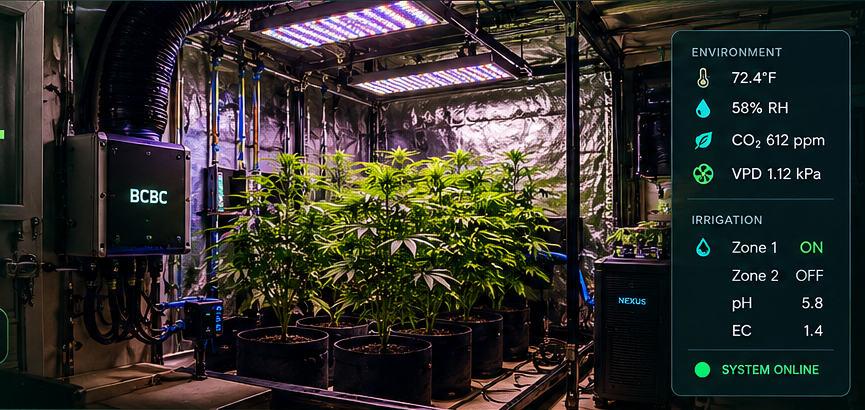
These concept renderings show the kind of physical integration BCBC is designing around: measured environments, serviceable sensor hardware and a local Nexus control layer.
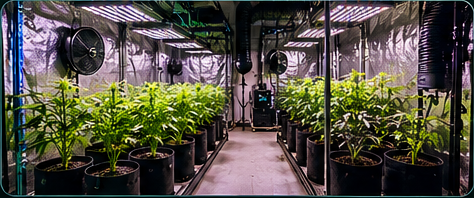
Bring temperature, humidity, CO₂, light, airflow and equipment state into one operating view.
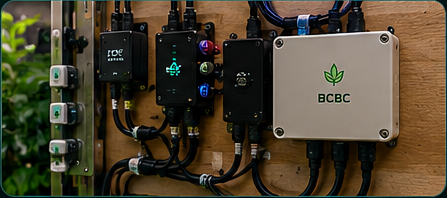
Use maintainable interfaces such as RS-485/Modbus, ESP32-class nodes and serviceable field wiring.
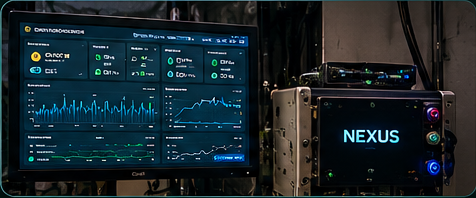
Coordinate zones, logging, alerts and AI-assisted interpretation through a local control layer.
We start by identifying what your grow needs to know, what equipment is already available, and which actions can be measured and verified.
Temperature, humidity, CO₂, light and airflow data can be brought together for a clearer picture of growing conditions.
Evaluate water temperature, level, flow, leaks, pH and EC monitoring and determine where alerts or automation make sense.
Explore connections among pumps, relays, lights, fans and existing controllers using compatible and serviceable interfaces.
Plan fixed cameras, visual history or drone-assisted inspection where appropriate to the site and operating requirements.
Give readings, alerts and equipment behavior a time history so troubleshooting starts with evidence instead of guesswork.
Use software to summarize trends and flag anomalies, with human review and practical safeguards around physical control.
Every cultivation environment behaves differently. Room geometry, plant load, lighting, irrigation, equipment capacity and outside conditions all change how a grow responds. BCBC is designed to measure each environment independently, coordinate shared equipment, verify the result and build useful operating history over time.
Sensor health, calibration history and independent measurements help distinguish a real environmental change from a failed or drifting sensor.
If a fan, pump, light or humidifier is commanded on, the system can watch for the physical response that should follow and flag a mismatch.
Operating history can reveal how quickly humidity changes, how irrigation affects conditions and how equipment interactions differ by zone.
Environmental readings, interventions, equipment changes, observations and results can become a searchable Grow Journal instead of disposable graphs.
BCBC Nexus and its accompanying ESP32 modules precisely and continuously monitor every environment, coordinating available intake, exhaust, humidification, cooling and other compatible equipment to maintain each zone as close to its configured environmental targets as practical. Each zone is measured independently; Nexus compares conditions, chooses an appropriate response, verifies the physical result and records what happened.
No setup. No manual. Press play and Nexus walks you through how it measures a grow, chooses a response, acts, verifies the result, and learns from what happened.
See Nexus measure independent grow zones, recognize changing conditions, coordinate available equipment, verify the physical result and return the environment to a stable state.
▶ WATCH NEXUS RUN A GROWSelect an illustrative condition and watch Nexus coordinate shared and zone-level equipment. The controller evaluates temperature and humidity together instead of allowing separate controls to fight each other. Example targets are configurable; this simulation uses 70–80°F and a 64–66% RH band.
Choose a scenario and run the cycle. Nexus will evaluate both environmental variables before selecting compatible equipment.
Stable temperature and humidity help reduce avoidable environmental water loss. Independent reservoir level and TDS/EC monitoring can then detect concentration drift and support a controlled fresh-water correction where the installation is designed for it.
Illustrative software simulation. Actual targets, equipment selection, sensor placement, hysteresis, minimum run/off times, interlocks and safety limits are site-specific. Temperature and RH targets vary by crop, growth stage and operating strategy.
Every independently managed tent or room can have its own environmental sensing, targets, equipment and history. Shared equipment can be coordinated across zones without pretending that one sensor represents the entire grow.
The installation defines the logic: serial or parallel airflow, available CFM, duct restrictions, exhaust capacity and equipment relationships determine what must be measured and how control decisions are made.
Essential environmental control can remain local and deterministic on Nexus and its field nodes. Higher-level intelligence can analyze trends, identify anomalies, explain decisions, learn response patterns and help optimize the grow without making Internet access a requirement for basic control.
Start with the room or tent, what is being grown, equipment already owned, current problems, budget and desired level of automation. That becomes the basis for a proposed architecture, measurement plan and staged implementation instead of a generic shopping list.
Automation should not just issue commands. It should check the outcome, record the result and let the operator know when reality differs from expectations.
Control and safety interlocks depend on the installed equipment, site-specific risk and approved scope.
The original BCBC diagram stays here as the technical reference: sensing, water/flow monitoring, the control layer, and the sense → verify → log → alert → improve loop.
Modular system concept. Individual functions require equipment compatibility and project validation.
You do not need to replace the entire grow to find value in better visibility. We can discuss one room, one system, or one expensive recurring problem.
Review your equipment, constraints, goals and current monitoring.
Identify compatible components, required validation and the expected operator workflow.
Agree on a deliverable, validate the result and decide whether broader integration is justified.
I'm William James of BCBC Technologies. If you operate a cultivation facility, greenhouse, hydroponic system or equipment business, I'd be interested in discussing your current setup and a practical first project.
Stay here and watch. Nexus will move through each condition automatically.